

Understanding a RAF Loss of Support Calculation
Quick Overview of a RAF Loss of Support Calculation
- Purpose: A Road Accident Fund (RAF) Loss of Support claim compensates dependents for the financial loss suffered when a family breadwinner dies in a motor vehicle accident in South Africa.
- Eligibility: Spouses, minor/dependent children, and indigent parents who had a proven legal right to financial support from the deceased qualify to claim.
- The Portion Formula: Income is allocated into standardised units—2 portions for a spouse and 1 portion for each dependent child or indigent parent (or 2 portions if an indigent parent lived with the deceased).
- Statutory Limit: Payouts are subject to a statutory annual cap adjusted quarterly for inflation (governed by the Road Accident Fund Act 56 of 1996).
- Actuarial Precision: Future career growth, inflation, contingency deductions, remarriage probabilities, and capitalisation rates require expert actuarial valuation for High Court litigation and settlement.
Navigating Financial Loss After a Fatal Road Accident
Experiencing the loss of a loved one in a road traffic accident is a devastating tragedy. Beyond the emotional shock, families frequently face immediate financial instability when the primary breadwinner passes away.
Under South African law, the Road Accident Fund (RAF) provides a statutory safety net that compensates qualifying family members for the loss of financial maintenance. However, determining the exact monetary value of future lost support involves complex legal principles, economic forecasting, and actuarial science.
Actuary Consulting provides specialised actuarial reports and expert witness testimony to ensure that loss of support claims accurately reflect historical earnings, future career trajectories, and statutory adjustments.

Who is Eligible to Claim RAF Loss of Support?
To submit a successful Loss of Support claim to the RAF, the claimant must prove that the deceased owed them a legal duty of support and was actively providing financial maintenance at the time of death.
Qualifying Dependents Include:
Legal and Customary Spouses: Wives and husbands (including civil, customary, and religious marriages) where a mutual duty of support exists.
Biological and Adopted Children: Minor children (under 18) or adult children who are financially dependent due to tertiary studies or physical/mental disability.
Indigent Parents and Grandparents: Parents who are unable to support themselves and relied on the deceased child for necessities.
Same-Sex and Cohabiting Partners: Partners in permanent relationships where a contractual or common-law duty of support can be established.
How is a RAF Loss of Support Calculated?
The fundamental principle behind a Loss of Support calculation is to place the dependents in the financial position they would have enjoyed had the deceased survived to normal retirement age.
The Standard Allocation Formula (The Portion System)
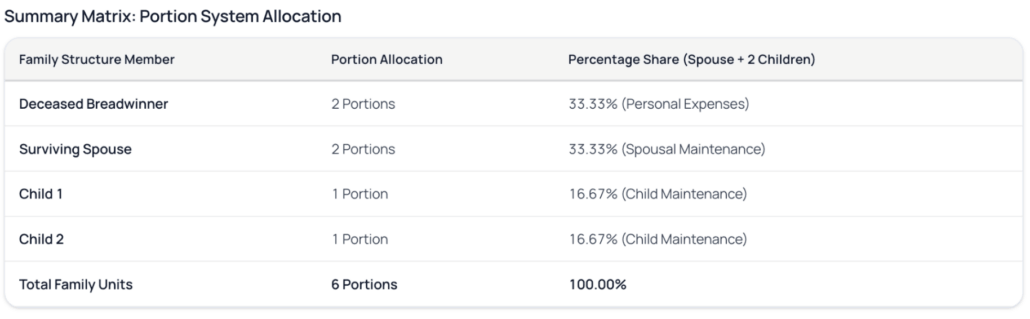
To determine how much of the deceased’s net income benefited each family member, South African courts and actuaries utilise the portion system. Income is split into hypothetical units based on family structure:
- Deceased Breadwinner: 2 Portions (allocated to personal living expenses)
- Surviving Spouse: 2 Portions
- Each Dependent Child: 1 Portion
- Indigent Parent (living separately): 1 Portion
- Indigent Parent (residing in the household): 2 Portions
Step-by-Step Calculation Methodology
-
- Calculate Monthly Net Income (MID): Determine the deceased’s actual net earnings at the date of death, adjusting for taxes, pension contributions, and realistic future salary growth.
- Determine Total Number of Portions (NP): Sum the allocated portions for the deceased, spouse, and all dependent children.
- Calculate Portion Value (PV): Divide the total net monthly income by the total number of portions.
- Calculate Dependent Maintenance Allocation:
Summary Matrix: Portion System Allocation
Practical Example Calculation Scenario
Consider an example to illustrate how the formula is applied before applying interest, inflation, and statutory caps:
- Deceased’s Monthly Net Earnings: R24,000
- Dependents: Surviving spouse and 2 minor children
Calculation Steps:
1. Total Portions: 2 (Deceased) + 2 (Spouse) + 1 (Child 1) + 1 (Child 2) = 6 Portions
2. Portion Value (PV): R24,000 ÷ 6 = R4,000 per portion
3. Spousal Loss of Support: 2 x R4,000 = R8,000 per month
4. Children’s Loss of Support: 1 xR4,000 = R4,000 per month per child. Total: R8,000/month
5. Deceased’s Personal Share: 2 x R4,000 = R8,000 per month. Deducted as personal maintenance.
Adjustments, Statutory Caps & Contingency Deductions
A raw mathematical calculation provides only the baseline. Actuaries apply several vital adjustments over time to comply with South African law and RAF legislation:
1. Evolution of Dependency Over Time
Family structures change, and calculations must adjust dynamically across projected time horizons:
Child Independence: As children reach age 18 (or 21–24 if completing tertiary education), their portion expires, and remaining household income is reallocated among surviving dependents.
Widow/Widower Remarriage: Statistical remarriage contingencies are applied to reduce the claim horizon if the surviving spouse has a high statistical probability of remarriage.
2. Statutory Inflation Caps (Section 17 of RAF Act)
Claims arising from accidents after 1 August 2008 are subject to a statutory annual cap on loss of support, adjusted quarterly by notice in the Government Gazette to reflect inflation. High-earning breadwinners whose income exceeds the cap have their claims proportionately reduced to comply with the statutory ceiling.
3. Contingency Deductions
Courts apply percentage deductions for the general “risks and vicissitudes of life”, such as potential future unemployment, illness, early death, or general economic downturns.
Typical baseline deductions range between:
- 5% to 10% for past loss of support.
- 10% to 15% for future loss of support (adjusted upward or downward depending on age and employment stability).

Claiming Covered Funeral Expenses
Under the Road Accident Fund Act, funeral costs are strictly limited to necessary, direct expenses associated with the burial or cremation.
Covered Funeral Items:
- Basic casket or coffin
- Undertaker and hearse services
- Grave fees and cremation costs
- Basic preparation and transportation of the deceased
Excluded Items:
- Refreshments, catering, and venue hire for mourners
- Tombstones and unveiling ceremonies
- Transport costs for family members and floral arrangements
Why Actuarial Expertise is Critical in RAF Claims
Calculating a RAF Loss of Support is not a static calculation. It requires modelling future promotion steps, inflation rates, discount rates (net present value), tax tables, and life expectancy tables.
The Actuary Consulting Advantage:
- 19+ Years of Actuarial-Legal Leadership: Trusted by leading South African attorneys and law firms.
- Rapid 24-Hour Turnaround: Delivering precise, court-ready actuarial valuations without litigation delays.
- High Court Expert Witness Support: Reliable expert testimony to substantiate claim quantum in disputed cases.
- No-Win-No-Fee Structure: Aligning with legal practitioners to ensure access to justice for claimants.
Frequently Asked Questions About RAF Loss Of Support Calculation
What is the statutory cap for RAF loss of support claims? The RAF loss of support cap is an annual limit set under Section 17 of the RAF Act. It is updated quarterly in the Government Gazette to compensate for CPI inflation. Claims above the statutory cap are capped proportionally across all dependents.
How long does a dependent child receive RAF loss of support? Loss of support for a child is typically calculated until the child reaches age 18. However, if there is evidence that the deceased would have funded tertiary education, the maintenance period can be extended to age 21 or 23.
Is a RAF loss of support payout subject to income tax in South Africa? No. Lump-sum compensation paid by the Road Accident Fund for loss of support or personal injury is tax-free in the hands of the recipient under South African tax law.
What happens if the surviving spouse remarries after the accident? When a surviving spouse remarries, the legal duty of support is assumed by the new spouse. Actuaries apply statistical remarriage contingency deductions, and support claims for the spouse generally terminate from the date of remarriage.
How does the RAF calculate loss of support if the deceased was unemployed? If the deceased was unemployed at the time of death, the claim can still succeed if it can be proven that the deceased had prospective employability, a trade skill, or reasonably expected future income.


