Road Accident Fund Articles – Guiding You In RAF Matters

Dealing with the aftermath of a road accident is never easy—especially when your financial future is uncertain. Whether you’re coping with the loss of a loved one or adjusting to a reduced income after injury, understanding your rights in a Road Accident Fund (RAF) claim is critical.

Our collection of RAF articles is here to guide you through the process step by step. We cover key topics like how compensation is calculated, when actuarial reports are needed, and what goes into building a strong, court-ready claim.

If you’re looking for clarity on a RAF loss of support calculation, we explain how actuaries determine what your family should receive—based on income history, dependents, and projected earnings.

At Actuary Consulting, we bring nearly 20 years of experience helping South Africans secure fair, accurate RAF compensation. Our articles are written to be practical, insightful, and easy to follow, whether you’re just starting your claim or already working with a lawyer.

Get empowered with the information you need to make the best decisions for your future. Start exploring our RAF articles today—because when it comes to compensation, knowledge is your strongest asset.

Raf loss of support calculation 2027 guide

Understanding a RAF Loss of Support Calculation

Quick Overview of a RAF Loss of Support Calculation

  • Purpose: A Road Accident Fund (RAF) Loss of Support claim compensates dependents for the financial loss suffered when a family breadwinner dies in a motor vehicle accident in South Africa.
  • Eligibility: Spouses, minor/dependent children, and indigent parents who had a proven legal right to financial support from the deceased qualify to claim.
  • The Portion Formula: Income is allocated into standardised units—2 portions for a spouse and 1 portion for each dependent child or indigent parent (or 2 portions if an indigent parent lived with the deceased).
  • Statutory Limit: Payouts are subject to a statutory annual cap adjusted quarterly for inflation (governed by the Road Accident Fund Act 56 of 1996).
  • Actuarial Precision: Future career growth, inflation, contingency deductions, remarriage probabilities, and capitalisation rates require expert actuarial valuation for High Court litigation and settlement.

Navigating Financial Loss After a Fatal Road Accident

Experiencing the loss of a loved one in a road traffic accident is a devastating tragedy. Beyond the emotional shock, families frequently face immediate financial instability when the primary breadwinner passes away.

Under South African law, the Road Accident Fund (RAF) provides a statutory safety net that compensates qualifying family members for the loss of financial maintenance. However, determining the exact monetary value of future lost support involves complex legal principles, economic forecasting, and actuarial science.

Actuary Consulting provides specialised actuarial reports and expert witness testimony to ensure that loss of support claims accurately reflect historical earnings, future career trajectories, and statutory adjustments.

actuaries working on a RAF loss of support calculation

Who is Eligible to Claim RAF Loss of Support?

To submit a successful Loss of Support claim to the RAF, the claimant must prove that the deceased owed them a legal duty of support and was actively providing financial maintenance at the time of death.

Qualifying Dependents Include:

Legal and Customary Spouses: Wives and husbands (including civil, customary, and religious marriages) where a mutual duty of support exists.
Biological and Adopted Children: Minor children (under 18) or adult children who are financially dependent due to tertiary studies or physical/mental disability.
Indigent Parents and Grandparents: Parents who are unable to support themselves and relied on the deceased child for necessities.
Same-Sex and Cohabiting Partners: Partners in permanent relationships where a contractual or common-law duty of support can be established.

How is a RAF Loss of Support Calculated?

The fundamental principle behind a Loss of Support calculation is to place the dependents in the financial position they would have enjoyed had the deceased survived to normal retirement age.

The Standard Allocation Formula (The Portion System)

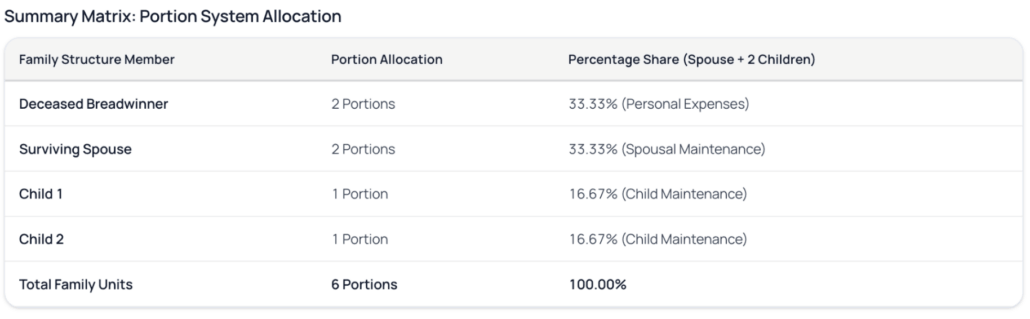
To determine how much of the deceased’s net income benefited each family member, South African courts and actuaries utilise the portion system. Income is split into hypothetical units based on family structure:

  • Deceased Breadwinner: 2 Portions (allocated to personal living expenses)
  • Surviving Spouse: 2 Portions
  • Each Dependent Child: 1 Portion
  • Indigent Parent (living separately): 1 Portion
  • Indigent Parent (residing in the household): 2 Portions

Step-by-Step Calculation Methodology

    1. Calculate Monthly Net Income (MID): Determine the deceased’s actual net earnings at the date of death, adjusting for taxes, pension contributions, and realistic future salary growth.
    2. Determine Total Number of Portions (NP): Sum the allocated portions for the deceased, spouse, and all dependent children.
    3. Calculate Portion Value (PV): Divide the total net monthly income by the total number of portions.
    4. Calculate Dependent Maintenance Allocation:

Summary Matrix: Portion System Allocation
summary matrix for a RAF loss of support calculation

Practical Example Calculation Scenario

Consider an example to illustrate how the formula is applied before applying interest, inflation, and statutory caps:

  • Deceased’s Monthly Net Earnings: R24,000
  • Dependents: Surviving spouse and 2 minor children

Calculation Steps:


1. Total Portions: 2 (Deceased) + 2 (Spouse) + 1 (Child 1) + 1 (Child 2) = 6 Portions
2. Portion Value (PV): R24,000 ÷ 6 = R4,000 per portion
3. Spousal Loss of Support: 2 x R4,000 = R8,000 per month
4. Children’s Loss of Support: 1 xR4,000 = R4,000 per month per child. Total: R8,000/month
5. Deceased’s Personal Share: 2 x R4,000 = R8,000 per month. Deducted as personal maintenance. 

Adjustments, Statutory Caps & Contingency Deductions

A raw mathematical calculation provides only the baseline. Actuaries apply several vital adjustments over time to comply with South African law and RAF legislation:

1. Evolution of Dependency Over Time

Family structures change, and calculations must adjust dynamically across projected time horizons:

Child Independence: As children reach age 18 (or 21–24 if completing tertiary education), their portion expires, and remaining household income is reallocated among surviving dependents.
Widow/Widower Remarriage: Statistical remarriage contingencies are applied to reduce the claim horizon if the surviving spouse has a high statistical probability of remarriage.

2. Statutory Inflation Caps (Section 17 of RAF Act)


Claims arising from accidents after 1 August 2008 are subject to a statutory annual cap on loss of support, adjusted quarterly by notice in the Government Gazette to reflect inflation. High-earning breadwinners whose income exceeds the cap have their claims proportionately reduced to comply with the statutory ceiling.

3. Contingency Deductions

Courts apply percentage deductions for the general “risks and vicissitudes of life”, such as potential future unemployment, illness, early death, or general economic downturns. 

Typical baseline deductions range between:

  • 5% to 10% for past loss of support.
  • 10% to 15% for future loss of support (adjusted upward or downward depending on age and employment stability).

happy family after correct RAF loss of support calculation

Claiming Covered Funeral Expenses

Under the Road Accident Fund Act, funeral costs are strictly limited to necessary, direct expenses associated with the burial or cremation.

Covered Funeral Items:

  1. Basic casket or coffin
  2. Undertaker and hearse services
  3. Grave fees and cremation costs
  4. Basic preparation and transportation of the deceased

Excluded Items:

  1. Refreshments, catering, and venue hire for mourners
  2. Tombstones and unveiling ceremonies
  3. Transport costs for family members and floral arrangements

Why Actuarial Expertise is Critical in RAF Claims

Calculating a RAF Loss of Support is not a static calculation. It requires modelling future promotion steps, inflation rates, discount rates (net present value), tax tables, and life expectancy tables.

The Actuary Consulting Advantage:

  • 19+ Years of Actuarial-Legal Leadership: Trusted by leading South African attorneys and law firms.
  • Rapid 24-Hour Turnaround: Delivering precise, court-ready actuarial valuations without litigation delays.
  • High Court Expert Witness Support: Reliable expert testimony to substantiate claim quantum in disputed cases.
  • No-Win-No-Fee Structure: Aligning with legal practitioners to ensure access to justice for claimants.

Frequently Asked Questions About RAF Loss Of Support Calculation

What is the statutory cap for RAF loss of support claims? The RAF loss of support cap is an annual limit set under Section 17 of the RAF Act. It is updated quarterly in the Government Gazette to compensate for CPI inflation. Claims above the statutory cap are capped proportionally across all dependents.

How long does a dependent child receive RAF loss of support? Loss of support for a child is typically calculated until the child reaches age 18. However, if there is evidence that the deceased would have funded tertiary education, the maintenance period can be extended to age 21 or 23.

Is a RAF loss of support payout subject to income tax in South Africa? No. Lump-sum compensation paid by the Road Accident Fund for loss of support or personal injury is tax-free in the hands of the recipient under South African tax law.

What happens if the surviving spouse remarries after the accident? When a surviving spouse remarries, the legal duty of support is assumed by the new spouse. Actuaries apply statistical remarriage contingency deductions, and support claims for the spouse generally terminate from the date of remarriage.

How does the RAF calculate loss of support if the deceased was unemployed? If the deceased was unemployed at the time of death, the claim can still succeed if it can be proven that the deceased had prospective employability, a trade skill, or reasonably expected future income.

Need Expert Assistance with a RAF Loss of Support Calculation?
For precise actuarial calculations, court-ready quantum reports, and expert witness support, contact Actuary Consulting
.

expert witness actuary in court

Interpreting Clinical Evidence for the High Court As An Expert Witness

When it comes to motor vehicle accidents or medical negligence litigation in South Africa, a judge is tasked with awarding a fair, mathematically rigorous quantum for financial loss. However, a court cannot rely on guesswork. To bridge the gap between initial injuries and a definitive, trial-ready calculation, legal teams rely on an independent expert witness actuary.

While an actuary does not medically diagnose a patient or project career paths on their own, they serve as the analytical anchor in the expert chain. They transform qualitative, raw clinical evidence from medical professionals into an authoritative financial value that stands up to cross-examination in the High Court.

The Medical-Actuarial Evidence Chain

An actuarial report does not exist in a vacuum. It relies heavily on the foundational expertise of two primary medical professionals to establish its baseline mathematical assumptions:

  • The Orthopaedic Surgeon (The Foundation of Impairment): The clinical assessment begins here. By evaluating bone, joint, and soft tissue damage, the Orthopaedic Surgeon completes the crucial Serious Injury Assessment Report (RAF 4 form). They establish a Whole Person Impairment (WPI) rating. The actuary reviews this clinical data to understand the anatomical baseline—determining the baseline physical limits that will affect the claimant’s long-term “life-years” and working longevity.

  • The Occupational Therapist (The Bridge to Daily Function): While the surgeon diagnoses the injury, the Occupational Therapist (OT) outlines how that injury manifests in real life. Their functional capacity evaluation determines specific physical limitations, such as an inability to lift weights, stand for extended periods, or sit at a desk without pain.

Translating Clinical Facts into Mathematical Assumptions

Once the clinical evidence is gathered, the actuary converts these physical restrictions into definitive proof of financial loss.

For instance, if an Occupational Therapist concludes that a specialised manual labourer can no longer lift heavy equipment, the actuary applies this qualitative restriction to the RAF Loss of Earnings calculation. The actuary uses these clinical findings to justify adjusting the contingency deductions (the percentage risk applied to future earnings) or compressing the claimant’s projected retirement age.

Without the medical reports, the actuarial math lacks an evidentiary foundation. Without the actuary, the medical reports remain a list of physical symptoms without a clear Rand value. Together, they create an unbreakable chain of expert testimony in the High Court that equips legal teams with an unassailable case.

Securing the Final Quantum

From analysing the initial RAF 4 clinical reports to calculating complex dependency ratios following a wrongful death, every step of the process requires absolute precision. Once a judge accepts this unified chain of evidence, the final phase involves securing the settlement itself—ensuring that all corporate or personal banking details are formally verified to facilitate the secure distribution of the awarded funds.

By turning raw clinical evidence into structured mathematical data, an independent expert witness actuary delivers the authoritative supporting documentation necessary to resolve high-stakes litigation efficiently.

Need a trial-ready actuarial valuation backed by an ironclad medical-legal analysis? Contact our team or learn more about instructing a specialised independent expert witness actuary in South Africa today.

Debris on a South African road with an ambulance in the background, representing the high severity of road accidents that necessitate professional RAF claim valuations.

An Actuarial Consultant Checklist for Your RAF Claim

The road safety crisis in South Africa remains a devastating reality, with 2025/26 festive season preliminary data recording 1,427 fatalities and 1,172 crashes in just over a month. 

While annual road deaths have seen a slight downward trend to approximately 11,418 in 2025, the severity of these incidents continues to shatter families across the country.

In the wake of recent catastrophic events, families are left not only with unimaginable grief but also with the daunting task of securing a future for those who survive.

While a lawyer manages the legal proceedings, an Actuarial Consultant is the expert responsible for translating these physical and emotional tragedies into a precise, court-ready financial figure. 

In personal injury and loss of support litigation, an Actuarial Consultant uses applied business mathematics to quantify uncertain future events, such as the career path a young learner might have taken, and converts those estimates into a lump-sum compensation amount.

To ensure your Actuarial Consultant can effectively bridge the gap between a legal claim and a fair financial settlement, you must be prepared with the following documentation.

See Our Services

A grieving family huddles together in mourning, illustrating the profound personal loss that an Actuarial Consultant helps quantify in loss of support claims.

The Master Checklist for Your Consultation

For an Actuarial Consultant to perform an accurate valuation, they require high-quality data. Incomplete documentation can lead to delays or a lower-than-expected settlement offer from the RAF.

1. Foundational Personal Documents

These documents establish the claimant’s legal identity and their relationship to any deceased breadwinners.

  • Copy of Identity Document (ID): Required for the claimant and, in death claims, the deceased.
  • Abridged or Unabridged Birth Certificates: Essential for any minor children included in a loss of support claim.

2. Evidence of Earnings and Employment

An Actuarial Consultant needs a detailed “financial map” of your life before and after the accident to calculate loss of earnings.

  • Pre-Accident Payslips: Ideally covering the 12 months prior to the accident to establish a baseline income.
  • Post-Accident Payslips: To demonstrate any reduction in income or “shortfall” caused by your injuries.
  • Tax Records (IRP5s or SARS assessments): Formal proof of historical earnings; if not available, you may need 36 months of bank statements.
  • Employer’s Certificate of Service: A formal letter detailing your job title, remuneration, retirement age, and “prospects of advancement”, information critical for forecasting future growth.
  • Bank Statements: Bank statements serve as a critical evidentiary tool, providing objective proof of financial loss by illustrating the disparity between pre- and post-accident income levels.

3. Medical and Medico-Legal Reports

While an Actuarial Consultant does not diagnose injuries, they rely on medical facts to set their mathematical assumptions.

  • Statutory Medical Report: A completed form from your doctor confirming the injuries.
  • Industrial Psychologist (IP) Reports: This is often the most important document for the actuary. The IP determines your likely career path, which the Actuarial Consultant then converts into a Rand value.
  • Serious Injury Assessment (RAF 4): Required if you are claiming general damages for “pain and suffering”.
  • Orthopaedic Surgeon (who does RAF 4 form): By assessing bone, joint, and soft tissue damage, the surgeon determines a Whole Person Impairment (WPI) rating, which the Actuary uses to justify the long-term “life-years” affected by physical disability.
  • Occupational Therapist: Their report outlines the specific physical limitations (e.g., inability to lift or sit for long periods) and future care needs, allowing the Actuarial Consultant to accurately calculate the cost of care and loss of productivity over a claimant’s lifetime.

4. Accident and Police Documentation

These documents establish the liability and “merits” of your case.

  • Official Police Accident Report (OAR) and Sketch Plan: Confirms the details of the incident.
  • Witness Statements: Supporting context that may influence the degree of liability the RAF accepts.

Why an Actuarial Consultant is Indispensable

The difference between a lawyer’s estimate and an Actuarial Consultant’s report can be hundreds of thousands of Rands. Here is why this expertise matters:

  • Forecasting Future Losses: An Actuarial Consultant uses complex models to account for inflation, mortality rates, and the “time value of money” (discounting future losses to a present-day lump sum).
  • Applying Contingencies: The courts typically apply “contingencies”, percentage deductions for life’s general uncertainties. An expert Actuarial Consultant ensures these deductions are fair and aligned with current case law.
  • Expert Witness Testimony: If the RAF disputes your claim amount, an Actuarial Consultant can testify in court as an expert witness, explaining exactly how the figures were derived.

Secure Your Future Today

Gathering these documents is the first, and most important, step toward a successful claim. Once your file is ready, a professional Actuarial Consultant can provide a valuation that serves as your most substantial leverage in negotiations. 

Don’t leave your financial recovery to chance. Contact us to book a preliminary review of your claim with a senior Actuarial Consultant.


Paramedics securing a man's neck brace inside a vehicle following an accident, highlighting the severe injuries that lead to complex damages and potential medical negligence claims.

The Actuary’s Role in Quantifying Damages

A fair settlement always requires more than just proving who is at fault; it requires accurately quantifying the economic loss suffered by the claimant. This financial damage is profoundly complex, encompassing decades of lost income, future medical expenses, and the devastating costs of lifelong care. Your RAF loss of support calculation really matters. 

The specialised expertise of actuaries from Actuary Consulting becomes essential, transforming complex, future uncertainties into a defensible, single present-day value.

Our role is to apply rigorous financial and statistical models, the same principles used to manage risk in insurance and pensions, to accurately quantify current and future economic damages for the claimant. 

A scientific approach ensures that settlements are robust, impartial, and withstand intense scrutiny in court.

A single running shoe lying on a road, illustrating a pedestrian accident and the resulting financial analysis required for the RAF loss of support calculation.

Talk to One of Our Actuaries

The Scope of Economic Loss

In a medical negligence case, the economic loss is typically categorised into several distinct heads of damages, each requiring detailed actuarial analysis.

1. Loss of Earnings and Earning Capacity

Often, the most significant component of a claim is when medical negligence results in permanent disability, which reduces or eliminates a claimant’s ability to earn an income. 

The actuary’s task is to determine the present value of the income the claimant would have earned over their working lifetime, had the negligence not occurred, versus what they are now projected to earn (or not earn).

  • Hypothetical Career Path: We establish a pre-morbid (pre-injury) career path based on evidence of education, skills, and industry trends.
  • Contingencies: We apply specific, evidence-based contingencies (or vicissitudes of life) for unemployment, illness, or premature death to both the pre-morbid and post-morbid scenarios.
  • Discounting: The future stream of lost income is mathematically discounted to its present-day lump sum value, ensuring the claimant receives a fair amount today that can be invested to cover their loss over time.

2. Cost of Future Medical and Care Expenses

This involves projecting the expenses necessary for the claimant’s care and well-being for the remainder of their natural life, including:

  • Medical Treatment: Surgeries, therapy, and specialised medical needs.
  • Assistive Devices: Wheelchairs, prosthetics, and home modifications.
  • Long-Term Care: The cost of full-time nursing or care assistants.

Actuaries model these costs, factoring in medical inflation, life expectancy assumptions, and the likely frequency of future expenditure, to determine a lump sum that accurately covers these future needs.

A cracked motorcycle helmet on a wet road at a crash scene, representing serious injury and the need for an accurate RAF loss of support calculation.

Specialised Applications: Dependency and the RAF

Actuaries also play a crucial role in quantifying loss in cases where the primary wage earner has died. This is also known as a loss of support claim.

The methodology is similar to the complex calculations used in Road Accident Fund (RAF) claims, where the actuary must calculate the loss suffered by the deceased’s dependents. 

  1. Projecting the Deceased’s Future Earnings: Determining the income the deceased would have earned over their expected working life.
  2. Calculating the Deceased’s Personal Expenditure: Determining the portion of the income the deceased would have spent on themselves (not the dependants).
  3. Determining Dependancy Loss: The remaining income is the amount that would have been used for the dependents’ support.
  4. Discounting to Present Value: The future stream of lost support is discounted to a present lump sum.

The precision required for the RAF loss of support calculation provides the framework for ensuring a dependant is financially secured following the loss of a breadwinner due to medical negligence.

Learn More About The Services We Offer

The Expert Choice for Quantification

When the stakes are high, you need a partner whose reports are not just accurate, but court-defensible. Actuary Consulting has become the trusted name for forensic actuarial valuations across South Africa. Here is why we are the professional choice for your medical negligence cases:

  • Expert Witness Credibility: Our actuaries are highly experienced in presenting and defending their reports under cross-examination in the High Court. This proven track record adds significant credibility and weight to your claim. Ensuring judges and opposing counsel respect the figures presented.
  • No-Win, No-Fee Arrangement: For attorneys handling claimant cases, we offer a no-win, no-fee arrangement on our reports. This unique client-centric billing model eliminates the financial risk of upfront fees. This enables legal teams to focus solely on achieving the best possible outcome for their clients.
  • Rapid Turnaround and Nationwide Presence: We understand that litigation often involves tight deadlines. We are renowned for our efficiency, with a commitment to providing a speedy turnaround time for urgent reports. Coupled with our nationwide network of offices, we offer unparalleled accessibility and speed across the country.

Don’t let the complexity of future financial losses compromise your client’s compensation. Partner with Actuary Consulting to transform uncertainty into a clear, scientifically supported claim for damages.


Our actuaries will assist you in drafting RAF loss of support claims

A Guide to RAF Claims & Financial Compensation

Navigating a Road Accident Fund (RAF) claim can be daunting, especially when your future financial stability is on the line. Whether you’re pursuing a RAF loss of support calculation after losing a loved one or need a precise RAF loss of income calculation due to injury, understanding how compensation is determined is crucial. For many South Africans, these calculations are not just about money but survival, dignity, and justice.

At Actuary Consulting, we specialise in quantifying the financial impact of road accidents with the accuracy and speed you need. If you’ve found yourself suddenly responsible for supporting a family (and scrambling to create an RAF loss of support calculation) or facing a future without the ability to earn, this guide will help you understand how actuarial reports support your claim, and ensure you’re not short-changed when it matters most.

Let’s unpack some of your pressing questions and help you gain a broader understanding when it comes to searches for ‘RAF loss of support calculation’ and ‘RAF loss of income calculations’:

Why Is Financial Compensation on RAF Claims Important?

A serious accident affects more than just your health. It can permanently disrupt careers, alter family responsibilities, and change your financial trajectory. That’s why financial compensation from the RAF plays a vital role in helping accident victims and their dependents recover with dignity.

If a primary earner can no longer work — or worse, has passed away — the economic ripple effects can last for decades. Compensation helps fill the income gap, covers medical bills, and ensures dependents are supported into the future. But to access this compensation, your claim must be backed by strong, objective financial evidence.

Get a quote from Actuary Consulting today for expert RAF loss of income or support calculations.

The Role of Actuarial Calculations in RAF Claims

Actuarial calculations determine the long-term financial losses resulting from an accident. These are typically submitted as part of the legal case and accepted by the courts as expert financial evidence.

There are two main types of actuarial reports frequently used in RAF claims:

  • RAF Loss of Support Calculation – Used when a breadwinner has passed away and the surviving dependents require financial compensation.
  • RAF Loss of Income Calculation – Used when an accident victim survives but can no longer earn the same income due to injury or disability.

Navigate the aftermath of a road accident with an RAF loss of income calculation

What Goes Into a RAF Loss of Support Calculation?

A RAF loss of support calculation estimates how much financial support the deceased would have provided to their family over time. It considers:

  • The deceased’s historical income
  • Likely future earnings had the accident not occurred
  • Tax, inflation, and deductions
  • The number of dependents and their share of support
  • Retirement age and career progression.

This information calculates a realistic, evidence-based compensation amount for the family’s loss of financial support.

What Is a RAF Loss of Income Calculation?

A RAF loss of income calculation is prepared when an accident victim survives but suffers a reduced earning capacity. This actuarial report compares two scenarios:

  1. What you were likely to earn had the accident never occurred
  2. What you are now able to earn post-injury, if anything

The difference between these two amounts, adjusted for inflation, taxes, and retirement, determines the total compensation owed.

We Answer Your Frequently Asked Questions (FAQs)

1. How long does it take to get an actuarial report for my RAF claim?

At Actuary Consulting, we guarantee a 24-hour turnaround for urgent RAF actuarial reports. We know delays can impact your case and peace of mind, so we prioritise speed and accuracy.

2. Who pays for the actuarial report?

There are no upfront fees required. We operate on a no win, no fee basis for attorneys and only invoice once the case is settled. If your claim is unsuccessful, you don’t pay.

3. Do I need an actuarial report for every RAF claim?

Not necessarily, but if your claim involves loss of earnings or support, a professionally prepared actuarial report significantly strengthens your case and increases your chances of receiving a realistic compensation.

4. Can I use Actuary Consulting even if I already have a lawyer?

Absolutely. We work alongside legal professionals to calculate and present your financial losses in a court-ready format. Many law firms rely on our expertise for this very reason.

5. Can Actuary Consulting appear as expert witnesses in court?

Yes, we provide expert high court witness services for all actuarial reports we produce. Our experienced team can testify and explain complex calculations clearly and credibly during litigation.

An actuary provides expert high court witness services explaining their RAF loss of support calculations

Why Do Accurate Actuarial Reports Matter?

The difference between a hastily prepared report and a professionally developed actuarial report can be hundreds of thousands of rands, or more. 

Courts rely on accurate, unbiased financial evidence to determine fair compensation. Without it, claims are often undervalued or disputed.

That’s why attorneys across South Africa trust Actuary Consulting for their RAF cases. Our reports don’t just tick boxes, they tell the financial story behind your loss with clarity and compassion.

Why Choose Actuary Consulting?

With almost 20 years of experience and recognition as one of the largest actuarial-legal firms in the country, Actuary Consulting is built to deliver results when it matters most.

We offer:

  • 24-hour turnaround time on urgent RAF reports
  • No win, no fee for attorneys
  • No upfront fees
  • Invoice only on settlement
  • Free service if your claim fails
  • Expert witness support in court

Whether you’re working through a loss of income or support claim, our actuarial reports are crafted precisely and tailored to your unique circumstances. We don’t just work with numbers, we work with people who need a way forward.

Request a quote today and let us help you receive the compensation you deserve.

Actuarial Report File with graphs

Unlocking the Power of Actuary Consulting Reports

In today’s complex legal and financial arena, precision and expertise are paramount when assessing claims, damages, or financial disputes. An actuarial consultant specialises in delivering a range of actuarial reports that provide clients with accurate, reliable, and defensible calculations. 

Below, we delve into the different types of reports offered, what each entails, and why these reports are indispensable. We’ve been assisting clients since 2008 with thousands of reports and have learned the difference it can make.

Our list of reports includes the following:

1. RAF Loss of Earnings

This report quantifies the income a person has lost due to injuries sustained in a motor vehicle accident. Actuaries consider pre- and post-accident earnings, potential career trajectory, and retirement age. The report accurately calculates financial loss by evaluating these factors, ensuring fair compensation.

How it helps our clients:

RAF Loss of Earnings Reports helps injured parties secure financial stability when they can no longer work as before. They also ensure that settlements are based on concrete financial assessments.

2. Medical Negligence

When healthcare services fail to meet acceptable standards, resulting in harm, actuarial reports assess the financial impact. These reports account for loss of earnings, future medical costs, and care requirements.

How it helps our clients:

Medical Negligence Claims require robust financial assessments to ensure victims receive compensation that covers both immediate and lifelong needs.

3. Commercial Litigation

These reports provide a detailed analysis of financial losses arising from business disputes, contract breaches, or unfair competition. Calculations may include loss of profits, damages to goodwill, or future earnings.

How it helps our clients:

In commercial disputes, having a detailed actuarial report can be the difference between winning and losing a case, offering clear, quantifiable evidence to support claims.

4. Divorce Accrual

Divorce Accrual reports calculate the growth in spouses’ estates during the marriage, ensuring a fair division of assets. Actuaries consider both tangible and intangible assets.

How it helps our clients:

Divorce Accrual Reports help ensure equitable settlements by providing a clear and unbiased valuation of accruals.

5. Personal Injuries

Personal Injury Reports assess the financial implications of injuries, including loss of income, medical costs, and pain and suffering. Factors like life expectancy and inflation are also considered.

How it helps our clients:

Accurate financial assessments ensure that injured parties are fairly compensated for their losses, giving them the resources needed to rebuild their lives.

Wooden manikin with injured leg and judge gavel.

6. PRASA Train Injuries

These reports focus on injuries sustained on trains operated by the Passenger Rail Agency of South Africa (PRASA). An actuarial consultant will evaluate loss of earnings, future medical care, and other damages.

How it helps our clients:

With increasing train-related incidents, these reports play a vital role in ensuring victims receive the compensation they deserve.

7. Intellectual Property

Actuarial reports in intellectual property disputes calculate damages arising from copyright infringement, patent violations, or trademark misuse. These include lost profits and licensing fees.

How it helps our clients:

Intellectual Property Reports safeguard innovation and creativity in the competitive business environment by quantifying losses effectively.

8. RAF Loss of Support

This report calculates the financial loss experienced by dependents due to the death of a breadwinner in a motor vehicle accident. Factors include the deceased’s income, career trajectory, and dependency ratios.

How it helps our clients:

RAF Loss of Support Reports provide dependents with the financial means to maintain their quality of life after a tragedy.

9. Future Maintenance

Future Maintenance Reports estimate the costs of maintaining children or dependents over a specified period, considering inflation and other economic factors.

How it helps our clients:

Future Maintenance Reports ensure that dependents are financially supported, helping claimants secure adequate resources for the future.

10. Labour Disputes

Labour Dispute Reports assess financial claims related to wrongful termination, workplace discrimination, or other employment issues. Calculations include lost earnings and potential career growth.

How it helps our clients:

Labour Dispute Reports offer clarity and evidence in often contentious workplace disputes, ensuring fair outcomes for both employees and employers.

11. Wrongful Arrest

Wrongful Arrest Reports quantify damages related to income loss, psychological trauma, and defamation following an unjust arrest.

How it helps our clients:

Wrongful Arrest Reports hold authorities accountable and provide victims with the compensation necessary to rebuild their lives.

lady getting a wrongful arrest report from her lawyers with the help of an actuarial consultant

12. Interest Calculations

Actuarial reports on interest calculations determine the value of delayed payments or outstanding debts, considering interest rates and compounding periods.

How it helps our clients:

Interest Calculations ensure transparency and accuracy in financial disputes, preventing overpayment or underpayment.

13. Defamation Damages

Defamation Reports assess the financial impact of reputational harm, including loss of earnings, business opportunities, or personal distress.

How it helps our clients:

Defamation Reports help claimants rebuild their professional and personal standing by quantifying reputational damage.

14. Criminal Matters

In criminal cases, actuarial consultants and their reports assess financial damages arising from crimes such as fraud or theft. They provide precise calculations to support restitution claims.

How it helps our clients:

Criminal Reports assist in the judicial process by offering objective, data-driven assessments of financial losses.

15. Deceased Estates Claims

Deceased estate claims reports evaluate the financial implications of estate disputes or claims, such as inheritance allocation or executor fees.

How it helps our clients:

Deceased Estate Claims Reports provide clarity and fairness in resolving estate matters, ensuring accurate and equitable distributions.

16. Inflation and Interest Adjustments

These reports calculate the impact of inflation and interest rate changes on long-term financial obligations or settlements.

How it helps our clients:

Inflation and Interest Adjustments ensure that financial settlements remain fair and reflective of economic realities over time.

17. Forensic Audits

Forensic Reports investigate financial discrepancies or irregularities, providing detailed analyses for legal or corporate use.

How it helps our clients:

Forensic Audits are vital in uncovering fraud, mismanagement, or financial misconduct, aiding in legal proceedings or corrective actions.

18. Statistical Calculations & Analysis

These reports leverage advanced statistical techniques to interpret data, offering insights for legal, business, or financial decisions.

How it helps our clients:

Statistical analyses provide comprehensive, evidence-based conclusions to support informed decision-making in complex scenarios.

19. Company and Asset Valuations

Company and Asset Valuation Reports assess the market value of businesses or assets for transactions, disputes, or strategic planning.

How it helps our clients:

Company and Asset Valuations provide accurate valuations critical for mergers, acquisitions, or resolving disputes.

The Importance of the Actuarial Consultant Reports

Actuarial reports are crucial in ensuring fair outcomes across various legal and financial contexts. Here’s why they matter:

  1. Accuracy and Objectivity

Actuarial reports are grounded in data, offering unbiased and precise calculations. This makes them invaluable in courts, tribunals, and negotiations.

  1. Clarity in Complex Cases

Many legal and financial cases involve intricate calculations. Actuarial reports break these complexities into clear, understandable figures.

  1. Supporting Justice

By providing reliable assessments, actuarial reports ensure that victims are adequately compensated, businesses are held accountable, and disputes are resolved fairly.

  1. Strategic Decision-Making

For legal teams, having a detailed actuarial report strengthens their case, helping them build compelling arguments and achieve better outcomes for clients.

Why Choose An Actuarial Consultant

Actuary Consulting brings extensive expertise, precision, and professionalism to every report. Their team understands the nuances of each case, tailoring their approach to deliver the most accurate and reliable assessments. We provide Expert High Court Witness services for all actuarial reports produced.

From RAF claims to defamation damages, actuarial reports are essential tools in today’s legal and financial environments. We provide clarity, ensure fairness, and support justice, making them a cornerstone of successful claims and disputes. 

For more information on how an actuarial consultant can assist you, contact us today and let our experts help you achieve the best possible outcomes. Learn more about what we offer in our informative blog.

RAF Loss of Earnings Calculation

Road accidents can have devastating consequences, often leading to severe injuries that impact a person’s ability to work and earn a living. The Road Accident Fund (RAF) provides financial compensation to individuals injured in motor vehicle accidents due to another party’s negligence. 

One of the most critical aspects of an RAF claim is the Loss of Earnings (LOE) calculation, which ensures that victims receive fair compensation for income lost due to their injuries.

Actuaries play a crucial role in these calculations, applying expert financial and statistical analysis to determine accurate and defensible claims. In this article, we will explore the concept of Loss of Earnings, how it differs from Loss of Support, and the key factors considered when calculating these claims.

What is Loss of Earnings?

Loss of Earnings refers to the income an individual is unable to earn due to injuries sustained in a motor vehicle accident. This calculation takes into account both past and future loss of income, ensuring that the injured party is adequately compensated for their inability to work at full capacity or return to their previous occupation.

Compensation for Loss of Earnings is designed to restore financial stability to the affected individual and prevent undue economic hardship resulting from an accident. However, these calculations require precise actuarial expertise to ensure fairness and accuracy.

Loss of Support vs. Loss of Earnings

While Loss of Earnings relates to an injured individual’s loss of income due to incapacity, Loss of Support pertains to dependents of a deceased breadwinner who have lost financial support due to the fatal accident.

Loss of Earnings: Compensation is paid to the injured party, who can no longer work as they did before.

Loss of Support: Compensation awarded to surviving dependents for the financial contributions they have lost due to the deceased’s passing.

Understanding this distinction is essential, as each claim requires different actuarial methodologies to determine accurate compensation.

Factors Considered in Loss of Earnings Calculations

Paramedics helping a lady who will have to make a loss of earnings claim at the RAF.

1. Pre-Accident Earnings

A fundamental step in LOE calculations is assessing the individual’s earnings before the accident. This includes:

  1. Salary or wages (fixed or commission-based)
  2. Bonuses and overtime pay
  3. Self-employment income and business profits
  4. Benefits such as pensions, medical aid contributions, or other allowances

Actuaries analyse employment history, tax records, payslips, and contracts to establish an accurate baseline for the injured person’s earnings before the accident.

2. Future Earning Potential

In addition to past earnings, actuaries assess how the injured individual’s career trajectory would have progressed had the accident not occurred. This involves estimating:

  1. Expected salary increases, promotions, or career advancements
  2. Inflation adjustments over time
  3. Potential job changes or new opportunities

Actuarial models consider economic trends, industry growth rates, and professional experience to project realistic future earnings.

3. Impact of Injuries on Work Capabilities

Not all injuries result in a complete loss of earning capacity. Some individuals may return to work but at reduced productivity levels or in lower-paying roles. Actuaries work with medical professionals to assess:

  1. Extent of physical and cognitive impairment
  2. Ability to perform job functions post-injury
  3. Potential need for retraining or career shifts
  4. Impact of disability on future earnings

For example, a construction worker who sustains a spinal injury may no longer be able to perform manual labour and may have to transition to a desk-based role with lower income potential.

An actuary calculating a RAF loss of earnings report.

The Role of Actuaries in Ensuring Accurate Calculations

Actuaries bring expert financial and statistical methodologies to RAF claims, ensuring that Loss of Earnings calculations are comprehensive, fair, and legally defensible. Their role includes:

Data Collection and Analysis: Gathering and interpreting relevant income records, industry salary trends, and medical assessments.

Future Income Projections: Using sophisticated financial models to estimate how earnings would have evolved without the accident.

Application of Contingency Deductions: Adjusting calculations for uncertainties such as life expectancy, career risks, and market conditions.

Preparation of Expert Reports: Providing clear, detailed actuarial reports that serve as evidence in legal proceedings.

Court Testimony: Acting as expert witnesses to support claims with data-driven justifications.

Why Accurate LOE Calculations Matter

Incorrect or incomplete Loss of Earnings calculations can result in either under-compensation (leaving victims financially vulnerable) or over-compensation (leading to disputes and legal challenges). By leveraging actuarial expertise, claimants and legal teams can ensure:

  1. Fair and equitable settlements aligned with actual financial losses
  2. Transparency and credibility in compensation claims
  3. Legal compliance with RAF claim requirements

Choose Actuary Consulting

Calculating Loss of Earnings in RAF claims is a complex process that requires precise actuarial analysis. With Actuary Consulting’s expertise, claimants and legal professionals can rely on accurate, defensible reports that support just outcomes.

For professional actuarial assistance in RAF Loss of Earnings calculations, contact Actuary Consulting today and ensure that your claim is backed by data-driven accuracy and expert insight. We can also assist you with fair and accurate RAF Loss of Support calculations.

An actuary calculating your RAF loss of support claim

Maximising Your RAF Claim: Tips From an Actuary

Beyond the emotional toll of losing a loved one, the experience often leads to significant financial hardship for dependents. Navigating the RAF claims process can be complex, particularly when dealing with a loss of support claim.

With their expertise in financial analysis, an actuary can provide invaluable guidance in understanding the intricacies of these calculations and maximising your claim. In this blog, we’ll delve into how RAF loss of support calculations work and offer practical tips on ensuring you receive the compensation you deserve. Let’s embark on this journey together.

Making Sense of RAF Loss of Support Claims

The RAF is a statutory body established to compensate individuals injured in road accidents or the dependents of those killed in such accidents. The loss of support claim is one of the key types of claims processed by the RAF, where dependents seek compensation for the financial loss suffered due to the death of the breadwinner.

RAF loss of support assistance

What is considered a loss of support?

Loss of support refers to the financial contribution the deceased would have provided to their dependents had they not died in the accident. This contribution includes income, benefits, and other financial support that would have been reasonably expected to continue had the breadwinner survived.

The Loss of Support claim compensates dependents for the loss of this financial contribution, ensuring that they are not left in financial distress following the tragic loss of their loved one.

The Role of an Actuary in RAF Loss of Support Calculations

Actuaries bring their expertise in mathematics, statistics, and finance to ensure that RAF loss of support claims are handled with precision and fairness.

  1. Determining Income: Actuaries begin by evaluating the deceased’s income through various documents, including payslips, tax returns, and employment contracts. To establish an accurate baseline, they meticulously account for all income components, such as bonuses and commissions.
  2. Projecting Future Income: They then project the deceased’s income if not for the accident. This involves considering factors like salary increases, inflation, career progression, and potential promotions. By using advanced mathematical models, actuaries make precise future income estimations.
  3. Assessing Contribution: Not all of the deceased’s income is included in the loss of support calculation. Actuaries determine the portion that would have been allocated to the dependents, considering expenses such as household costs, education, and healthcare.
  4. Accounting for Contingencies: Life is unpredictable, and actuaries factor in potential contingencies, such as job loss, early retirement, or other events that could impact financial support. They apply contingency deductions to ensure that the compensation reflects realistic future scenarios.
  5. Calculating Present Value: Actuaries calculate the present value of the future support the deceased would have provided, considering the time value of money. They use discount rates to convert future amounts into a lump sum that fairly compensates the dependents.

father and daughter being compensated the correct RAF Claim amount thanks to an actuary

Maximising your RAF claim with Actuary Consulting

Navigating the RAF claims process can be complex. With the right expertise, you can maximise your claim and ensure that your dependents receive the compensation they deserve. Actuary Consulting is your go-to expert for RAF loss of support calculations, offering specialised services to guide you through every step.

  1. Accurate financial assessment: We calculate the present value of future financial support that the dependents would have received if the breadwinner had lived. This includes factors like the deceased’s income, future earning potential, inflation, and life expectancy.
  2. Expert testimony: We often serve as expert witnesses in court, providing credible and impartial testimony that supports the claim. Our calculations are based on sound actuarial principles, making them reliable and persuasive.
  3. Comprehensive documentation: We provide a detailed report that outlines the methodology used, assumptions made, and the final calculation of the loss of support. This documentation strengthens the claim by providing clear evidence of the financial loss.
  4. Strategic contingency planning: We also consider potential future changes or uncertainties, such as remarriage or changes in the dependents’ needs, and factor these into the calculation to ensure a fair and realistic compensation amount.
  5. Maximising compensation: By accurately quantifying the loss, we help ensure that the compensation awarded to the dependents is appropriate, preventing under- or over-compensation.

The loss of a breadwinner is devastating, and ensuring that your dependents are financially secure is of utmost importance. Navigating the RAF claims process can be daunting. With the right actuarial expertise, you can maximise your claim and secure the compensation your family deserves.

Actuary Consulting stands as an expert in RAF loss of support reports. We provide the guidance and support needed to successfully navigate the process. Trust in our expertise and contact us to help you secure a fair and just outcome for your family.

actuarial consultant

The Actuarial Consultant: Experts Behind the Numbers

Legal claims and financial assessments require greater precision and expertise than ever before. Actuary Consulting, a prominent South African company, is at the forefront of this field, offering a comprehensive range of indispensable actuarial reports for attorneys and claimants. 

With over 17 years of experience and a stellar track record, Actuary Consulting has solidified its reputation as a leading actuarial consulting firm in South Africa. 

Let’s explore their various services and highlight the expertise needed to navigate the intricate world of actuarial reports. Comprehensive Actuarial Services

Actuary Consulting offers various actuarial services designed to meet clients’ diverse needs. Here’s an overview of the primary reports Actuary Consulting can provide:

Road Accident Fund (RAF) Loss of Earnings Claim: This report evaluates the financial loss from a road accident. It focuses on the claimant’s diminished earning capacity. 

Road Accident Fund (RAF) Loss of Support Claim: This analysis determines the financial support lost by dependents due to the death or incapacitation of the primary earner in a road accident.

Personal Injury Claims: These reports assess the financial implications of personal injuries, calculating compensation based on the extent of the injury and its impact on the claimant’s life. 

Third-Party Liability Claims: This involves evaluating a third party’s financial liability in incidents leading to personal injury or loss.

Medical Negligence Claims and Malpractice: These reports quantify the financial damage from medical negligence or malpractice, essential for both defence and plaintiff cases.

Divorce Maintenance Claims: This service calculates the lump sum value of future maintenance payments in divorce proceedings, ensuring fair financial support based on both parties’ financial status and needs.

Accrual Calculations in Divorce Matters: These reports assess the growth in the value of each spouse’s estate during the marriage, which is crucial for equitable distribution in divorce settlements.

Deceased Estates Claims: This service involves valuing estates and determination of rightful claims by beneficiaries.

Inflation and Interest Adjustments: Adjusting financial claims for inflation and interest ensures that the compensation reflects current economic conditions.

Forensic Audits: These audits are critical for uncovering financial discrepancies and ensuring transparency in financial statements. Forensic Audits are also provided to determine the earnings of self-employed individuals and business owners.

Statistical Calculations and Analysis: Providing detailed statistical analysis for various financial and legal purposes.

Company and Asset Valuations: These valuations are essential for mergers, acquisitions, and financial reporting.

actuarial consultants shaking hands

Expert High Court Witness Services

One of Actuary Consulting’s standout features is its provision of expert High Court witness services. Their actuarial consultants are proficient in producing detailed and accurate reports and defending them in court. This capability ensures that the analyses hold up under scrutiny, providing credible support for legal cases. 

Nationwide Presence and Rapid Turnaround

Actuary Consulting has a significant presence across South Africa, with offices in Johannesburg, Pretoria, Durban, Cape Town, Port Elizabeth, Bloemfontein, East London, Polokwane, Mbombela, and Rustenburg. This extensive network ensures clients have easy access to their services, regardless of location.

In addition to their broad geographical presence, they are renowned for their rapid turnaround times. Actuary Consulting prides itself on a 24-hour turnaround for actuarial reports. A testament to its efficiency and commitment to client satisfaction.

Client-Centric Approach

Their client-centric approach is evident in their billing practices. For attorneys handling Road Accident Fund, medical negligence, and personal injury claims, they offer a no-win, no-fee arrangement. This means that attorneys do not have to pay upfront fees or deposits. They are only invoiced upon the successful settlement of a claim. 

A Legacy of Excellence

Established in 2008, the team of more than 10 actuarial specialists has produced over 10,000 reports. Each is meticulously crafted to meet the highest standards of accuracy and reliability. The company’s extensive experience and proven track record make us a trusted partner for legal professionals and claimants.

Actuary Consulting stands for precision and expertise in complex legal claims and financial assessments. Its comprehensive range of actuarial reports, expert High Court witness services, nationwide presence, rapid turnaround times, and client-centric billing practices make it the premier actuarial consultant in South Africa.

Whether you are dealing with a Road Accident Fund claim, personal injury case, medical negligence issue, or any other financial assessment, contact the experts behind the numbers in your area to ensure that every report is a testament to their dedication to accuracy and excellence – putting their clients first.